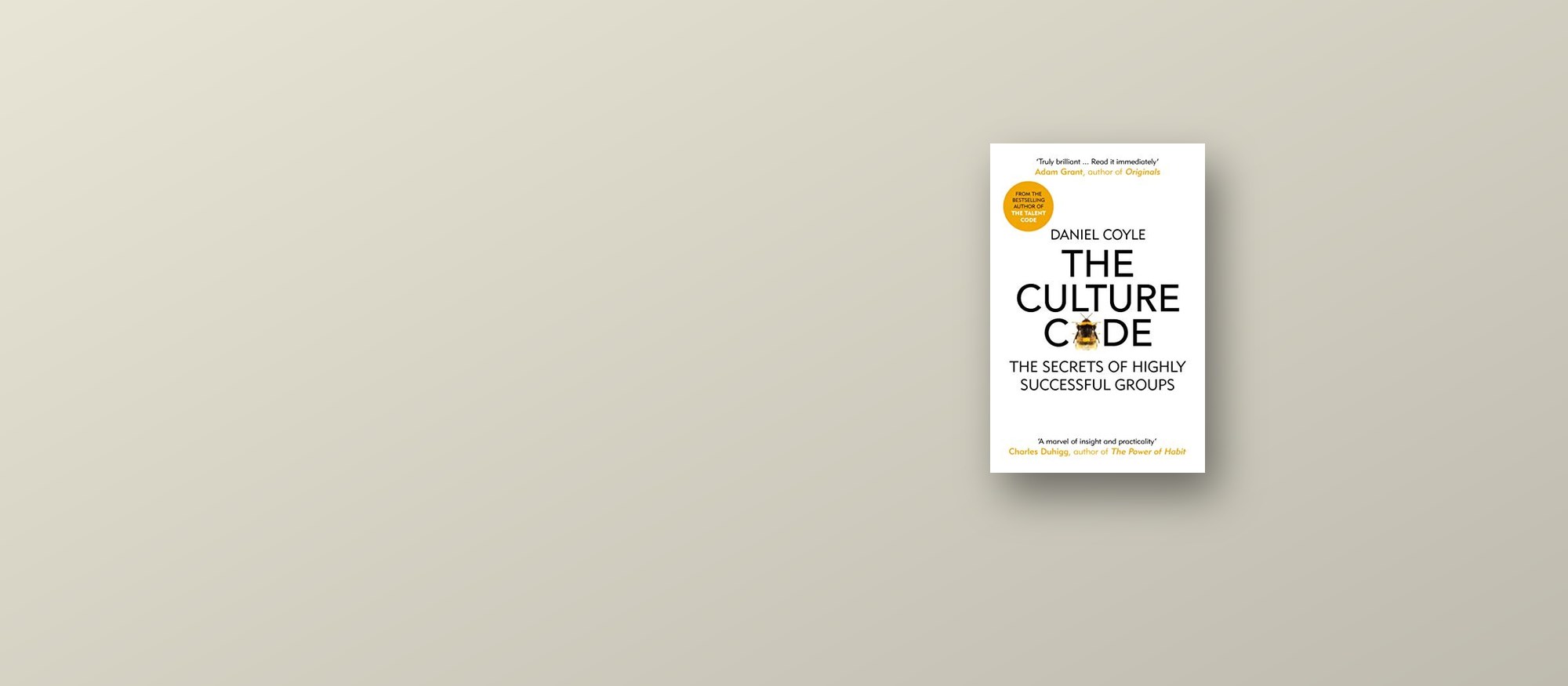
"The Culture Code: The Secrets of Highly Successful Groups," by journalist Daniel Coyle, opens with a question most owners assume they already know the answer to: what actually makes one group of capable people outperform another equally capable group. Coyle spent years inside organizations that outsiders consider unusually effective, including a U.S. Navy SEAL unit, the design firm IDEO, and an NBA franchise, and he found the same pattern showing up in places that otherwise had almost nothing in common. High-performing teams weren't smarter or more talented than average ones on paper. They were better at a small, repeatable set of behaviors that told each member, moment to moment, that the group was a safe place to take a risk. Coyle calls these behaviors "belonging cues": things as small as sustained eye contact, turn-taking in conversation, or a leader admitting a mistake out loud in front of the team. None of them look like a management technique on their own. Stacked together and repeated consistently, Coyle argues, they add up to something a team can feel before anyone can name it, and its absence is just as easy to sense, even when nothing is being said directly. The book organizes its findings around three skills rather than one grand theory: building safety, so people register the group as a place worth investing effort in; sharing vulnerability, so admitting a problem becomes routine instead of risky; and establishing purpose, so the group has a shared, specific answer to what it's actually trying to accomplish together. Coyle treats all three as ordinary, learnable habits rather than personality traits some leaders happen to have and others don't, which is part of why the book reads more like a field manual than a theory of leadership.
Vulnerability doesn’t come after trust — it precedes it. Leaping into the unknown, when done alongside others, causes the solid ground of trust to materialize beneath our feet.
— Daniel Coyle, "The Culture Code"
That claim runs against how most owners are taught to think about trust: that it has to be earned first, slowly, before anyone takes a real risk in front of the group. Coyle's research points the other direction. Teams that built trust fastest were the ones where someone, usually a leader, went first: admitted uncertainty, asked for help, or owned a mistake before being caught in it, which gave everyone else permission to do the same. The mechanism behind this shows up clearly in outside research too. Gallup's own workplace data found that only three in 10 U.S. employees strongly agree their opinions count at work, and modeled what happens if that number moves to six in 10: a 27% reduction in turnover, a 40% reduction in safety incidents, and a 12% increase in productivity, all tied to the same underlying condition Coyle describes at the team level. A June 2026 analysis in Fortune, drawing on the same body of Gallup engagement data, found employee engagement had fallen to its lowest point in more than a decade, and pinned much of the gap on a mismatch between what leaders believe they're projecting and what employees are actually experiencing day to day. That's the exact failure mode Coyle warns against: a leader who talks about openness without ever practicing the small, visible behaviors that make openness feel real to the people watching. Coyle is careful to note that none of this requires a personality overhaul. Belonging cues are learnable habits, not fixed traits, which is why he spends much of the book cataloguing specific, repeatable behaviors rather than abstract principles about culture.
reduction in employee turnover Gallup found when workplaces move from 3-in-10 to 6-in-10 employees strongly agreeing their opinions count at work, alongside a 40% drop in safety incidents and a 12% productivity gain. Gallup, "How to Create a Culture of Psychological Safety" →
The pattern Coyle documents maps closely onto what GH Group's Culture Overhaul™ engagement is built to address: a 12-month process that runs the full Inside-Out Method™ (Story, Structure, People, Market) specifically because culture problems rarely trace back to a single policy or perk. They trace back to dozens of small daily signals, repeated or missing, across an entire organization. The Structure phase of that method is where an owner typically identifies which of those signals are missing: unclear decision rights, meetings where the same three people do all the talking, or a habit of solving problems quietly instead of naming them in front of the team, all of which read as an absence of Coyle's belonging cues even when nobody involved would describe it that way. What Radical Candor Actually Looks Like in Practice covers similar ground from a different angle: both pieces land on the idea that direct, honest feedback only works inside a team that already feels safe enough to receive it, which is Coyle's argument in different language. "The Culture Code" isn't a step-by-step operating manual, and Coyle is upfront that belonging cues look different in a 12-person sales team than in a 200-person manufacturing floor; a reader looking for a rigid checklist to apply company-wide will find the book more descriptive than prescriptive. It works better as a way of noticing what's already happening, or not happening, inside a team's daily interactions, which is the same starting point Culture Overhaul™ uses before recommending any structural change. GH Group doesn't have a confirmed read of this specific title from Gary the way it does for a few other titles on this list; it's included here because the belonging-cues pattern matches what GH Group already sees in owner-led businesses working through team trust issues, not as a personal endorsement beyond that.