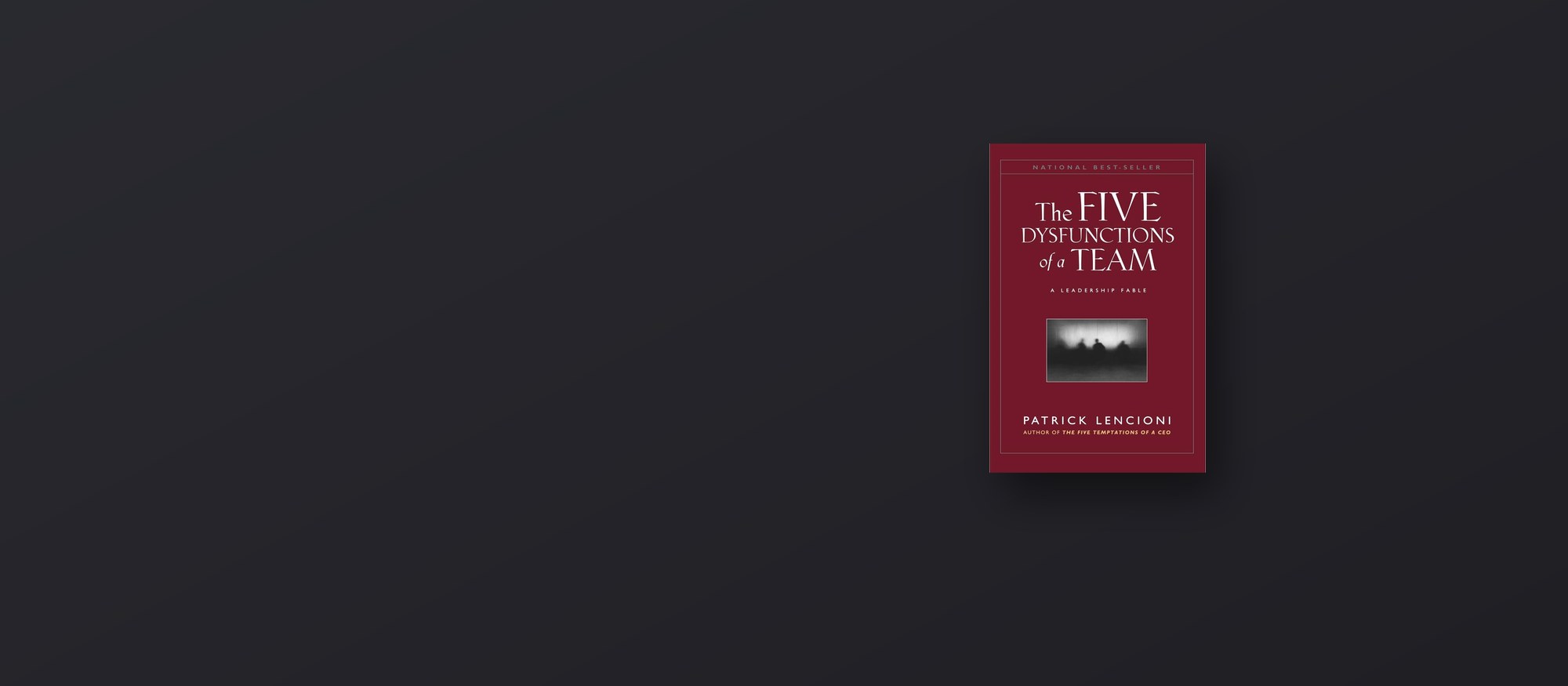
When your leadership team sits down together, do they say what they think? Or do they nod, leave the room, and go do what they were already planning to do? That question sits underneath The Five Dysfunctions of a Team by Patrick Lencioni, which belongs on this list because it explains in plain language why capable people on the same payroll still fail to act like a team. Lencioni wrote it as a business fable. A new CEO, Kathryn Petersen, takes over a struggling Silicon Valley company called DecisionTech and has to unite an executive team that looks strong on paper and works poorly in practice. Along the way the book builds a five-part model, stacked like a pyramid, in which each layer rests on the one beneath it. At the bottom is absence of trust. Above it sit fear of conflict, lack of commitment, avoidance of accountability, and, at the top, inattention to results. The order is the point. A team that doesn’t trust each other won’t argue honestly, a team that doesn’t argue honestly won’t fully commit, and a team that never committed has nothing to hold each other accountable to. Results suffer last, which is exactly why owners tend to chase them first. That sequence is why the book sits beside the chapter of our Business Owner’s Playbook on building a high-performing team, and it matches the order of work in the Inside-Out Method™, where the foundation gets built before anyone is asked to perform.
It is teamwork that remains the ultimate competitive advantage, both because it is so powerful and so rare.
— Patrick Lencioni, "The Five Dysfunctions of a Team"
Trust sits at the base for a reason, and the research supports the order. When Google studied 180 of its own teams, 115 engineering project teams and 65 sales pods, it concluded that what mattered was less about who was on the team and more about how the team worked together. Of the five dynamics its researchers ranked, psychological safety came first (opens in new tab), meaning team members feel safe taking interpersonal risks such as admitting a mistake or offering a new idea. Dependability, structure and clarity, meaning, and impact followed. Lencioni’s bottom layer and Google’s top finding are the same idea in different clothes. I describe trust in three layers when I work with a client. The owner has to trust the consultant. Leadership has to show employees that open communication and dialogue carry no consequences. And employees have to believe the leader won’t reprimand them for making a mistake and failing forward. Those layers take time, and people are watching all the time to see whether your behavior stays consistent. An owner who says “tell me what you think” and then reprimands the first person who does has taught the entire room to go quiet. Trust builds the other way: you acknowledge the effort, you say what to do next time, and you are “patient enough to allow them to fail forward.”
Fear of conflict is the second layer, and it is the one most owners misread. Lencioni’s point is that a team avoiding disagreement ends up with artificial harmony, polite meetings, and decisions that die afterward in the hallway. Healthy disagreement needs ground rules so that people argue about the issue and not about each other, and it needs a leader who doesn’t punish the person who raised it. Commitment comes next, and here Lencioni and I agree on something practical: people commit to what they have helped shape and can see in writing. When I talk about commitment with clients, it starts with the vision, the mission, and the company commitments, kept consistent across every document, repeated at a monthly meeting held every single month, and pointed to again and again until employees can say them back.
teams studied in Google’s team effectiveness research. Psychological safety ranked first of five dynamics, ahead of dependability, structure and clarity, meaning, and impact. Google re:Work, Understand team effectiveness →
Accountability and results are the top of the pyramid, and they are where Lencioni’s model and my own experience line up most closely. Employees don’t resist accountability when expectations are clear, written down, and said out loud. They resist it when it shows up as a surprise. Employees who have sat through a half-hearted program before often miss that a more palatable workplace also means “more accountability.” Once the expectations live in job descriptions and standards of performance, accountability stops being the owner’s private burden and becomes something the team shares. In the companies I’ve worked with, productivity has been documented to rise 15% to 50% once those tools are in place and reinforced. I can’t say how much of that is trust, conflict, commitment, or accountability individually, because they feed one another. That is the best argument for reading Lencioni’s book as a system and not as a checklist.
A few fair limits. The model comes from a consultant’s experience and a fable, not from a controlled study, and the story centers on a senior executive team at a technology company, so a 30-person shop will need to translate some of it. The book also leaves the owner’s own behavior in the background more than I would. In most businesses I see, the team takes on the personality of whoever runs it, whether anyone designed it that way or not, and a leader who avoids hard conversations will get a team that avoids them too. Its value to an owner is as a diagnostic you can run in an afternoon. Ask five questions. Do my people tell me the truth when it is uncomfortable? Do they disagree with each other in front of me? Can each of them state what we have committed to? Do they hold each other to it, or wait for me to do it? And do we measure results the same way across the whole team? Wherever the first honest “no” falls, that is the layer to build next. If you want help finding it, Culture Overhaul™ is where we start, or you can contact us first.