
Must Reads
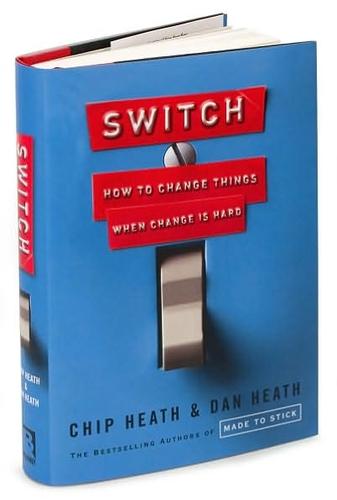
Switch
Switch by Chip Heath and Dan Heath belongs on this list because it explains why organizational change stalls and what a business owner can do about it. The brothers build the whole book on one image, borrowed from psychologist Jonathan Haidt: a Rider sitting on top of an Elephant. The Rider is the thinking side of a person, the part that plans and weighs options. The Elephant is the emotional side, and it supplies the energy. When the two disagree for any length of time, the Elephant wins, because it weighs six tons and the Rider doesn't. Add a third piece, the Path, meaning the situation and environment around both of them, and you have the book's whole framework: give the Rider clear direction, give the Elephant a reason to care, and shape the Path so the new behavior is the easy one. Most change efforts inside a small or midsize business work on only one of the three, usually the Rider, with a memo, a slide deck, or an all-hands announcement, and then the owner wonders six months later why nothing moved. That pattern is why Switch sits beside the first chapter of our Business Owner's Playbook, the one about building a roadmap for transformation. It also tracks closely with the order of work in the Inside-Out Method™, where culture change begins with what the owner makes clear and commits to, before anyone asks employees to behave differently.
What looks like resistance is often a lack of clarity.
— Chip Heath & Dan Heath, "Switch"
The timing makes this book more useful now than when it came out in 2010. Gallup's State of the Global Workplace 2026 (opens in new tab) report describes employee engagement as a measure of readiness for change, and it names AI as a major disruption that engaged organizations tend to absorb better. The same report found that manager engagement dropped from 27% to 22% between 2024 and 2025, the steepest one-year decline in its trend line. Put those two findings side by side and you get a familiar picture: companies asking managers to lead people through new software, new AI tools, and new reporting structures at the moment those managers have the least left to give. The Heaths would recognize it right away. One of their three surprises about change is that what looks like laziness is often exhaustion, since self-control runs out, and every new habit a person has to supervise in themselves draws from the same limited supply. The surprise I'd put on every owner's desk is a different one: “What looks like resistance is often a lack of clarity.” I see this in almost every company I walk into. More than 90% of the organizations I'm introduced to don't have a written vision statement, a mission statement, company commitments, job descriptions with standards of performance, or an org chart. If you have 100 employees and none of that exists in writing, you have 50 to 100 different directions the business is headed, and most of what the owner reads as pushback traces back to missing direction. Once those documents are written and reinforced with everyone, something consistent happens. People who have been sitting on ideas start coming forward and telling the owner they'd been reluctant to speak up until now. That's the Rider getting the clarity it needed all along.
of respondents reported a successful transformation when line managers and frontline employees were not engaged, versus 26% to 28% when they were. McKinsey & Company Global Survey →
The Elephant is where most owners lose the room. McKinsey's global survey on organizational transformations (opens in new tab) found that when a company failed to engage its line managers and frontline employees, just 3% of respondents reported a successful transformation, compared with 26% and 28% when each of those groups was engaged. Only 39% of respondents said their organization had built broad ownership of the change. That lines up with what I watch happen inside client companies. Employees who have seen a few initiatives come and go are dubious that the owner means it this time, and a new policy won't convince them. The first visible sign that the Elephant is starting to move is usually the owner standing up before the whole staff and admitting that he or she hasn't given people the tools and communication they needed. The Heaths tell a similar story about a manager at a large manufacturer who could have built a spreadsheet on wasteful purchasing and instead piled hundreds of mismatched work gloves, each tagged with its price, on the boardroom table. Executives who would have skimmed the numbers stood there and felt the problem.
The Path is the piece owners skip most often, and it's the one I'd start with. Shaping the Path means changing the situation instead of lecturing the people in it: expectations in writing, the same monthly meeting held every single month, and job descriptions that spell out what good performance looks like. Structure makes the new behavior the default, so nobody has to rely on willpower to keep it going. That's the core of Culture Overhaul™, which we frame as a one-year project from the start, because there are no overnight results unless the owner is prepared to make overnight changes. One fair limit belongs here. Switch was written for a broad audience, with examples ranging from hospitals to grocery aisles to family life, so anyone hoping for a step-by-step change plan for a 60-person company won't find one in its pages. Its value for an owner is a diagnostic that takes an afternoon to run. When a change stalls, ask three questions. Is the direction concrete enough for an employee to act on it tomorrow morning? Do people care about the outcome, or do they only understand it? And does the way work is set up make the new behavior easier or harder than the old one? A stalled initiative usually comes up short on at least one of those, and the fix rarely requires launching another program. For a closer look at how written plans lose momentum before they reach the team, see Most Strategic Plans Never Make It Off the Page.