
Must Reads
Scaling Up
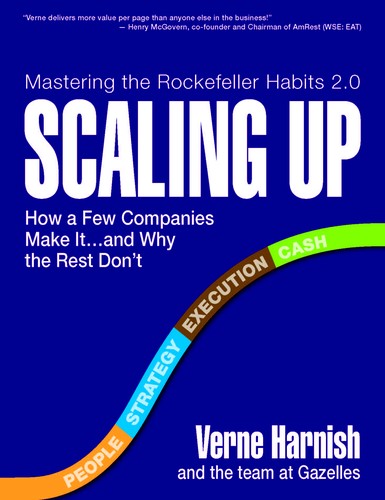
Most owners I talk to assume their business stalled because sales dried up. That's almost never what happened: the systems that got the business started stopped being enough to run what it became, and nobody built the next set to replace them. That's the whole argument behind Scaling Up, and it's a book I point clients toward often. Verne Harnish, founder of the Entrepreneurs' Organization and CEO of the executive-education firm now called Scaling Up, built the book around that one claim: growth doesn't stall for lack of demand nearly as often as it stalls for lack of the internal structure to handle it. Harnish traces the idea back to his first book, "Mastering the Rockefeller Habits," named for the daily discipline John D. Rockefeller reportedly used to run Standard Oil; "Scaling Up," first published in 2014, expanded that framework into a full system for companies well past the startup stage. The book has sold more than 500,000 copies, been translated into 22 languages, and won eight international business book awards, and it remains one of the standard references in the operating-systems category of business writing.
Scaling up is every entrepreneur's dream — and nightmare. Hypergrowth is terrifying, and it's most often success that kills great companies.
— Verne Harnish, "Scaling Up"
Harnish organizes the whole discipline into what he calls the Four Decisions: People, Strategy, Execution, and Cash. I recognize every one of these in the businesses I work with, usually breaking down in the exact order Harnish describes. People means building a real leadership bench: what he calls A-players organized as a functioning team, not a founder still fielding requests that a working manager should already own. Strategy means writing a plan sharp enough that a competitor couldn't claim it as their own, condensed onto a single page instead of buried in a planning binder nobody reopens after the retreat that produced it. Execution turns that plan into a short, fixed list of measurable priorities each quarter, reviewed on a fixed weekly schedule instead of whenever the calendar allows it, a discipline Harnish's own coaching firm has scaled to more than 200 partners across six continents. Cash is the decision he treats as the most dangerous to ignore: growth consumes cash well before it produces it, and a business that scales its revenue without scaling its cash discipline can outgrow its own bank account, sometimes within a single busy season. The book's central tool, the One-Page Strategic Plan, forces all four decisions onto a single sheet a leadership team can keep in front of them at a standing weekly meeting, paired with the Rockefeller Habits Execution Checklist™, a self-assessment scored against the specific habits Harnish documented across the fastest-growing companies in his research. More than 80,000 companies have run some version of their planning through these tools since the book's release, which tells me less about Harnish's personal authority than about how little comparable structure most businesses already have in place when they first pick the book up.
of small business owners with five or fewer employees still handle their own administrative and finance work personally, leaving little time to build the systems that let a business grow past them. Simply Business, 2026 Small Business Growth Gap Report →
That gap is easy to see in the businesses I work with. Simply Business's 2026 Small Business Growth Gap Report (opens in new tab), based on a March 2026 survey of 1,092 U.S. business owners with five or fewer employees, found that 80% still handle their own administrative and finance work personally, and 54% named a lack of time as the single biggest barrier to growing the business at all. Those numbers describe Harnish's Execution and Cash decisions breaking down in small, unnoticed ways: an owner buried in bookkeeping has no functioning system distributing that work to anyone else, and a business with no fixed weekly structure beyond the owner's own calendar has nothing ready to hand off once it's time to grow past the point one person can manage it alone. The Inside-Out Method™ targets that exact gap on the structure side, and my own piece on the three systems every business needs before it scales covers the process-and-authority angle of it directly; Scaling Up adds the piece those frameworks treat more lightly, a specific discipline for tracking cash as growth speeds up rather than after it's already caused a problem. A leadership team working through my coaching programs would recognize the shape of Harnish's One-Page Strategic Plan immediately: it's the same instinct behind boiling a strategy down to what a team can hold in its head during a working session, rather than what looks impressive in a binder nobody opens again. One caveat worth naming plainly: Harnish writes for a business that has already found paying customers and is trying to grow past them, so an owner still searching for a first repeatable customer will get more out of solving that problem first than out of adopting a four-decision operating system built for the stage after it.