
Must Reads
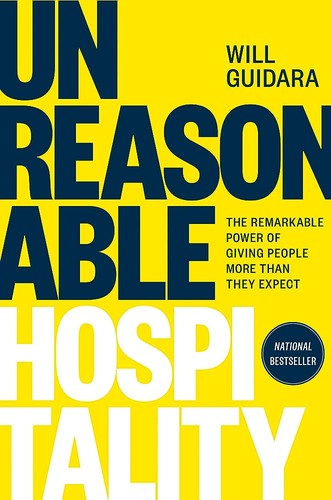
Unreasonable Hospitality
Will Guidara ran the dining room that helped turn a good restaurant into the best in the world, and his book Unreasonable Hospitality makes a claim I have built my whole career around without ever using his exact words for it: you cannot hand a customer a better experience than the one your own team is having. Eleven Madison Park, the New York restaurant where he worked, climbed to the top of the World’s 50 Best Restaurants list on his watch, largely because he refused to treat hospitality as something you bolt onto good service after the fact. He draws a line between the two: service is getting the right plate to the right table on time, and hospitality is how the person at that table feels while it happens, a distinction that translates directly to a repair shop, a dental office, or any business where a customer walks through a door. That distinction shows up plainly in Gallup’s own numbers: business units in the top quarter for employee engagement post 10% higher customer loyalty (opens in new tab) than the bottom quarter, alongside 23% higher profitability. The team’s experience and the customer’s experience move together. They don’t move separately.
Excellence is the culmination of thousands of details executed perfectly.
— Will Guidara, "Unreasonable Hospitality"
Guidara found the same thing I’ve found in 35 years of doing this work: a team can’t hand a customer something it doesn’t have itself. He got rid of restaurant rules that existed only to protect the business from its own staff, and gave servers real authority to spend money on a guest’s behalf without checking with a manager first. When he hired, he wasn’t screening mainly for restaurant experience. He wanted people who were, in his words, curious about what they didn’t know and generous with what they did, because that combination is what makes someone notice a guest instead of just serving one. The trust ran in both directions once that team was in place. Servers kept a running log of small details, including a couple’s anniversary, a regular’s favorite table, or a kid’s stuffed animal left behind on a prior visit, then used it to build small surprises into a night nobody had asked for. In the most famous case, a server overheard a table mention they’d never had a real New York hot dog before flying home that afternoon. Without asking permission, she left the building, bought one from a street cart, and had the kitchen plate it properly before it reached the table. That gesture cost about two dollars. What made it possible wasn’t a bigger budget. It was a team given the authority, and the expectation, to actually pay attention: a server allowed to notice something small and act on it, repeated across thousands of tables until it became how the whole restaurant operated.
higher customer loyalty in business units with top-quartile employee engagement compared with bottom-quartile, alongside 23% higher profitability. Gallup Q12 Meta-Analysis (11th Edition) →
I watched this exact principle play out with a longtime client of mine, an independent auto-repair shop owner, years before I ever read Guidara’s book. A customer brought a car in for repair, and somewhere in the process, the shop made a mistake on the work. Rather than argue about fault or split the difference, he spent $5,000 of his own money fixing the car right, because that’s what the culture he’d built said his business did for people. It wasn’t in a script anywhere. He’d built a real vision, mission, and company commitments, specific enough that his team knew what “we take care of people” actually meant in a moment like that one, not just a line on a poster in the break room. That’s the connection I keep coming back to with “Unreasonable Hospitality”: the gesture only works because the culture underneath it is real. A restaurant, a repair shop, or any small business can copy the hot dog story, and it will read as a stunt if the values behind it aren’t genuinely built and communicated first.
That’s exactly the order the Inside-Out Method™ insists on: culture, structure, and expectations get defined before you ever ask an employee to go the extra mile for a customer, because a team that isn’t cared for internally has nothing extra to give. My own Culture Overhaul™ engagements start from that same order, not the reverse, since a company that skips straight to a customer-service training day is usually trying to harvest fruit from a tree nobody planted. It’s fair to name one limit here: Guidara was running a four-star restaurant with a check average most small businesses don’t have, and not every gesture in the book scales down directly to a 20-person company watching its margins closely. What does scale down is the discipline behind it, and the first move is smaller than it sounds. Pick one employee-facing rule that exists only to protect the business from its own team, and remove it. Give your people real authority within a boundary you’ve defined, build a team curious and generous enough to notice what a customer needs before being asked, and treat hospitality as something the whole culture produces, not a script handed down once a year at a training meeting nobody remembers by spring.