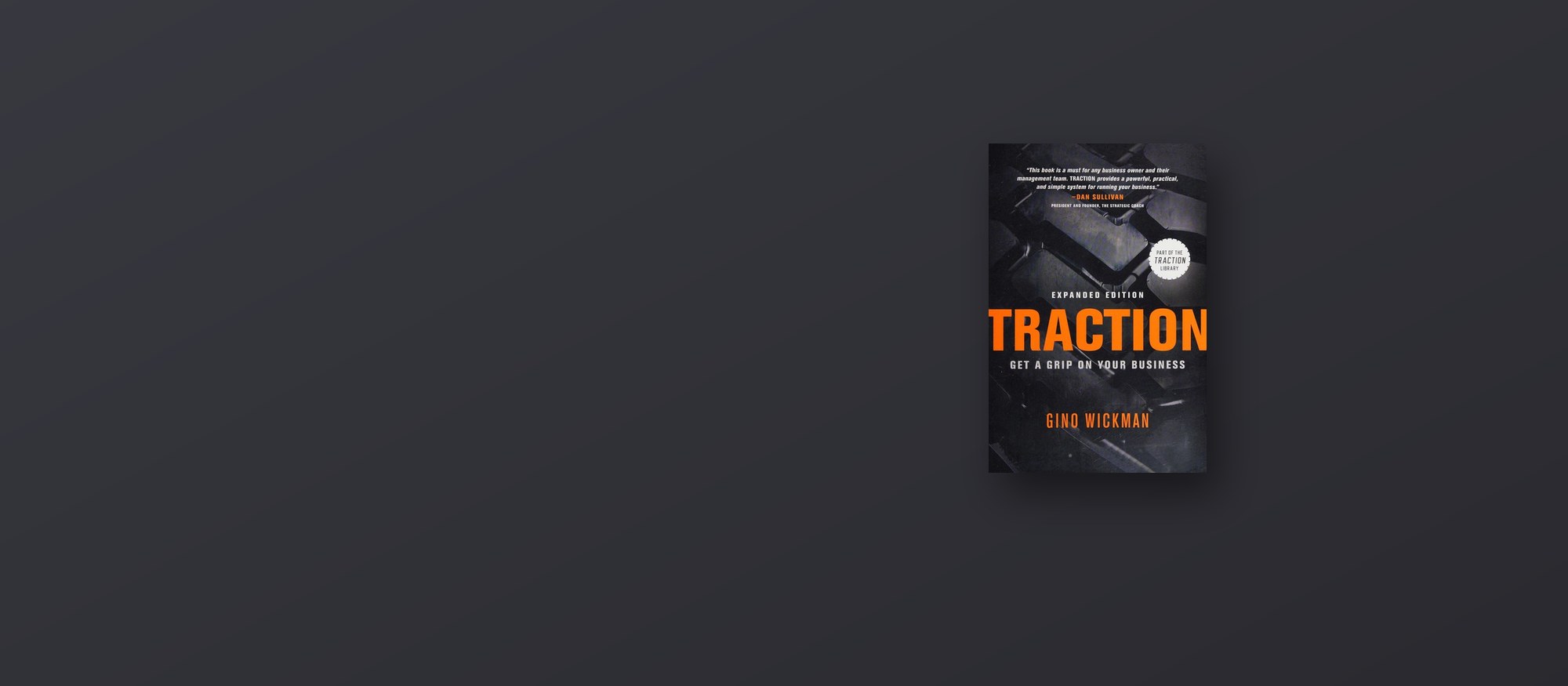
"Traction: Get a Grip on Your Business," by Gino Wickman, introduced what's become one of the most widely adopted small business operating frameworks in the country: the Entrepreneurial Operating System, or EOS. The premise is straightforward even if the execution takes real discipline: most growing businesses don't fail from a lack of ambition, they fail from a lack of structure, specifically the absence of a shared operating system that tells everyone in the company how decisions get made, how problems get solved, and how the team stays aligned once the business gets too big for the owner to personally touch every decision. The framework has had real staying power in the years since its release. By recent count, EOS is now used by more than 130,000 companies worldwide (opens in new tab), a scale that puts it well beyond a passing management trend and closer to a default operating language for small and mid-sized businesses trying to professionalize how they run.
Most growing businesses don't fail from a lack of ambition. They fail from a lack of structure.
What makes the book useful isn't any single tool inside it. It's the argument that six specific components (vision, people, data, issues, process, and traction itself, the discipline of actually executing the plan) have to work together, and that most businesses are strong in one or two of these areas while quietly weak in the rest without realizing it. A company might have a crystal-clear vision and a strong team but no real data discipline, so nobody notices a problem until it's already expensive; another might have excellent process documentation but no forum where issues actually get raised and solved, so the same problem resurfaces every quarter without ever getting permanently fixed. Wickman's insistence on addressing all six components together, rather than picking a favorite and ignoring the rest, is what separates the book from a narrower productivity framework: it's a full operating system, not a single technique borrowed from somewhere else.
companies worldwide now run on the EOS framework introduced in "Traction." ScaleUpExec, "How Many Companies Run on EOS?" →
The overlap with GH Group's own approach is direct, even though the vocabulary differs. Where EOS names six components, the Inside-Out Method™ organizes the same underlying problem around Story, Structure, People, and Market, but the diagnosis is consistent across both frameworks: businesses that depend entirely on the owner's judgment in the moment, rather than a system everyone can run, hit a ceiling that effort alone can't push past. For an owner who's never used a structured operating system before, "Traction" is a genuinely practical starting point, concrete enough to implement a piece of it the same week it's read, which is part of why it's held up as a staple recommendation for so long. Owners who read it and recognize the "strong in one area, weak in the rest" pattern in their own business may find that a focused, time-boxed engagement, the kind built into Focus 90, is a faster way to close that specific gap than trying to rebuild every system at once.